Writer, businessman, online educator, husband, father, grandfather--promoting and practicing biblical free-market principles for achieving, and helping others to achieve, success.
View all posts by Paul Ramirez →
Today’s observance of Martin Luther King Day seems like a good time to compare the racial and political ideologies that gave rise to the civil rights movements of the 1950s and 60s — and the creation of the national holiday honoring King in the 1980s — with the biblical and historical motivations that undergird the theology and tactics of Christian Resistance.
King’s prominent role in the civil rights movement as an ordained Christian minister — and liberal Baptist preacher — certainly gave the movement its religious, righteously indignant tone and flavor in the media. But it was always a political movement, first to last. And the goal was always a political one: equal rights under the law. Which was another way of saying blacks had a right to the same unequal and unfair treatment under the same bureaucratic and corrupt system of tyranny and excessive taxation that whites enjoyed. “Now, that’s worth marching for!”
The civil rights movement and especially the Civil Rights Act of 1964 were originally championed on the right, believe it or not, by conservatives and Republicans. But, of course, once its political potential as a catalyst for the justifiable expansion in the role of government — meaning the expansion in the role and power and enrichment and career enhancement of government-paid employees: politicians — to intrude into the lives and wallets of private citizens for the sake of “equality” became apparent, the movement was co-opted by members of the Left and adopted as their own cause, and a new ideological banner was created to wave in their opponents’ faces and cast in the teeth of conservatives. “Take that, you bigoted, civil rights proponents, originators and pioneers!”
It was not “Christian resistance” per se. At best, you could say it was baptized political activism. Sort of like “liberation theology,” but without all the guns and Marxist trappings.
Christian resistance, as defined and presented in the following two books, is quite different.
Rather than providing a blueprint to seize and utilize the levers of tyrannical power and political mobilization to right wrongs and correct injustices, it offers a grassroots, theologically- and biblically-motivated, broad-based effort that begins with this: resisting the tyranny lawfully and peacefully while exposing and opposing the erroneous, unbiblical and ungodly theories and ideologies that caused the problem in the first place. It then moves to providing Bible-based alternatives and solutions that will, in the long run, fix what is broken.
But first, as you will see, the nature of the problem — how we got here — has to be stated and understood, along with the principles and doctrines and biblical examples that validate and warrant, and even mandate, the proffering and strategic implementation of a “Christian” solution.
Let’s look at the backdrop. In the 1970s, the civil rights movement nationally had pretty much run its course and faded from the public consciousness as a political force and nightly news-maker. Now, war, military escalations, economic unrest, social and cultural turmoil that began in the decade before and continued as a thriving counter-culture, the spread of a militant atheism and secular humanism using the tax-funded institutions of government and public education to spread its poison and consolidate and expand its power, the erosion of traditional morality and values, etc., all combined to expose the obvious void and very noticeable absence of a self-consciously biblical, systematic Christian strategy and game plan to combat these problems and address these issues.
By the early 1980s, the nascent school of historic, orthodox, Calvinistic, eschatologically optimistic, theological school of thought known as Christian Reconstruction, was coming into its own and beginning to make its presence felt — a very unwelcome presence as far as many conservative evangelicals and fundamentalists were concerned!
Newsletters gave birth to books, which gave birth to more books. Volumes and volumes of literary “blueprints” written explicitly for Christians to begin getting a theological and intellectual grip and handle on things. Not a moment too soon. Conservatives, especially Christians, having rediscovered political activism, were lulled into a false sense of victory in 1980 thinking they had “won” the grand prize when they got Ronald Reagan into the White House. Wrong! The battle was only escalating and intensifying.
For this reason, in 1983, the following two volumes were published in the Christianity and Civilization series of the Geneva Divinity School:
Edited by Dr. Gary North and Rev. James B. Jordan, these two books were meant to be handbooks and manuals for Christians to read and understand, (a), what it is we are facing — and have been facing for quite some time! — and, (b), what it is we can, and must, do about it.
Their content and message are no less relevant and no less required reading for us today.
And so, on the occasion of Martin Luther King Day 2014, and in light of the growing liberty movement and slow but steady political awakening of the public to the across-the-globe problem of tyranny, it seems like an awfully wise and timely thing to do to embark on (for some) a new reading of these now-thirty-year-old books! For those of us who are not waiting around biding our time hoping for a certain imminent cataclysmic event to deliver us instantly and mercifully from the exigencies and weighty and urgent responsibilities of building Christ’s kingdom by first deconstructing Satan’s counterfeit kingdom and its corrupt influences, the task of taking the time to identify the nature and causes and history of the problem, and then systematically and patiently but proactively and confidently addressing and dealing with them and ultimately, by God’s grace, power and wisdom, solving them once and for all, is not such a tall order.
Both of these books are free and can be downloaded right here:
Multiple authors contributed numerous articles and essays that comprise these two very informative and insightful volumes. But their individual viewpoints do share one common theme:
According to my one-year Bible-reading plan, I should have finished reading the book of Revelation sometime around New Year’s Eve.
Well, as luck God’s providence would have it, that didn’t happen. I am still reading, still making my way through the final chapters.
That’s good. Because, in doing so, I felt compelled to pull out (and dust off) my hardcover copy of David Chilton’s block-buster magnum opus: his 700-page, verse-by-verse commentary on the book of Revelation, The Days of Vengeance.
Holy interpretive maximalism, Batman!
Just kidding. I will not join the throngs of Reformed — and not-so-Reformed — critics who dismiss the views expressed in this bulky but highly readable tome as springing from the fevered imagination of an otherwise gifted pastor and theological-hermeneutical heavyweight such as Chilton.
I am not worthy to loose the sandal strap — had I been anywhere near his vicinity while he was still alive — of this former missionary kid and Southern California transplant turned likable lightning-rod of biblical, postmillennial eschatology.
Let me say at the outset that this book, The Days of Vengeance: An Exposition of the Book of Revelation, belongs on every Christian’s book shelf and in every pastor’s library. Period.
Why?
Because whether you read it or not, whether you agree or disagree with Chilton’s provocative and evocative analysis and invariably consistent interpretive approach to Scripture, you need this book in your midst if for no other reason than to bear witness to the fact that, Yes, Virginia, there is an evangelically uncompromising, conservative, Calvinistic, Bible-believing commentary on the most misunderstood, misinterpreted and scrupulously avoided (by many pastors and commentators) of all the 66 books of the Bible, that ISN’T either amillennial or premillennial!
Chilton pays excruciatingly close attention to every word in the text, seeking to uncover not only what it says, but why it says what it says.
The mark of a good Bible teacher is that he is constantly asking: Why is the story told in this particular way? Why is this particular word or phrase repeated several times? (How many times?) What does this story have in common with other stories? How is it different? Why does the text draw our attention to seemingly unimportant details? How do the minor incidents fit into the argument of the book as a whole? What literary devices (metaphor, satire, drama, comedy, allegory, poetry, etc.) does the author use? Why does the book sometimes depart from a strict chronological account (e.g., placing some stories “out of order”)? How are these stories related to the larger Story that the Bible tells? What does this story tell us about Jesus Christ? What does this story have to do with our salvation? Why did God bother to give us this particular information?
Hard to argue with that.
Like his previous (and equally polarizing) book, Paradise Restored, The Days of Vengeance raises the bar, sets the course and bends the arc of biblical hermeneutics towards an eschatologically optimistic, dominion-oriented, presuppositional and covenantal perspective of Scripture for all future commentaries that might and should be written, not only on the Revelation of St. John the Divine but also on the other sixty-five books of the Holy-Spirit-breathed, self-authenticating text of God’s holy Word!
I, David Chilton, was in Tyler, Texas on the Lord’s Day
If I were to attempt a real, honest-to-goodness, thorough book review of Days of Vengeance, it would probably either turn this into a 5,000-word blog post, or else an interminable series of installments that would drag out like a D. Martin Lloyd Jones sermon series, and seem like I’ve got nothing else to write about! (I do, really.) So, I’ll be brief.
After a Foreword by British theologian Gordon J. Wenham, his Author’s Preface, Publisher’s Preface by Gary North and then a lengthy (and highly informative) Introduction, Chilton divides the book into five parts.
Did you get that? Five parts. He does this deliberately. VERY deliberately!
These five parts correspond exactly with the five-part covenant model that Rev. Ray Sutton had discovered shortly before Chilton finished writing the book, which caused him to rejigger the manuscript and complete it a few months later after three and a half years of work. It fits beautifully with the five-part covenant structure found in Deuteronomy and (as Dr. North discovered) in the Ten Commandments and throughout Scripture.
So, in the final published edition, here is how the book is divided:
Part One, the Preamble: Revelation chapter 1.
Part Two, Historical Prologue: letters to the seven churches (Rev. 2-3).
Part Three, Ethical Stipulations: the seven seals (Rev. 4-7).
Part Four, Covenant Sanctions: the seven trumpets (Rev. 8-14).
Part Five, Covenant Succession and Continuity: the seven chalices (Rev. 15-22).
That pretty well constitutes the lion’s share of the contents, obviously. After this, there is Chilton’s epilogue, “Conclusion: The Lessons of Revelation,” followed by three very helpful appendixes (appendices) which should be read just as earnestly as the rest of the book:
Appendix A, “The Levitical Symbolism in Revelation,” by Phillip Carrington
Appendix B, “Christian Zionism and Messianic Judaism,” by James B. Jordan
Appendix C, “Common Grace, Biblical Eschatology and Common Law,” by Gary North
A bibliography and three separate indexes (indices!) push the book past the 700-page mark when all is said and done.
Something that Chilton makes crystal-clear as far as his methodology is concerned, right up front in the first two pages of his Author’s Preface, he refers to the five “crucial interpretive keys” which he uses to guide his textual exposition throughout the commentary.
They are:
Revelation is the most “Biblical” book in the Bible. (He explains why.)
Revelation has a system of symbolism. (He refers to the “systematic structure” and unique biblical “language” in which it was written.)
Revelation is a prophecy about imminent events. (This places him squarely in the preterist camp of biblical prophecy.)
Revelation is a worship service. (He places great emphasis on the “very considerable liturgical aspects of Revelation.” calling attention to it because “the worship of God is central to everything in life.”)
Revelation is a book about dominion. (It’s “not a book about how terrible the Antichrist is, or how powerful the devil is.” It is about Christ’s lordship over all things and “our salvation and victory in the New Covenant.” Amen to that.)
Contrary to popular opinion, Chilton states emphatically that the book of Revelation is NOT an “apocalyptic” book. It is not intended by God (or John) to be a cryptic and obscure, mysterious, nearly-impossible-to-understand -without-a-dispensationalist-prophecy-professional-to-help-you-understand-it collection of weird, scary symbols and “secret” code words. No, the symbolism and language that were used by St. John were commonly understood in his day, being “rooted firmly in the Old Testament” — which is why we 20th and 21st-century readers (even evangelical and Reformed) have such a hard time trying to figure it out!
Speaking of scary, Chilton points out that, “though John depicts evil realistically, his book is fundamentally optimistic.” He contrasts the contemporary apocalyptic literature of the day with the biblical prophetic literature, summing up their stark difference in this way:
The apocalyptists said: The world is coming to an end: Give up! The Biblical prophets said: The world is coming to a beginning: Get to work!
Yes!
It is this unsinkable, unflappable tone of historical optimism and victorious confidence in the triumph of the Gospel and the Christian church prior to the Lord’s returns that permeates all of Chilton’s commentary on Revelation, and is what sets it apart from all the others.
Also, his very illuminating inclusion of excerpts and important historical details from the works of Flavius Josephus (The Jewish War) and Alfred Edersheim (The Life and Times of Jesus the Messiah) make his case for first-century fulfillment of the majority of the prophecies in Revelation that much more compelling.
So, if you’re looking for a book on the Book of Revelation that will help you truly understand the unfamiliar biblical language and symbolism of it — even though Pastor Joe Morecraft (whom I respect and admire greatly) says DON’T go near Chilton’s book, Paradise Restored, or the interpretive maximalist school of interpretation he adheres to — you can either buy the book (somewhere) as a hardcopy, or else download it FOR FREE in a number of places.
(Reading The Days of Vengeance and taking the time to write this brief review has allowed me to veer from my one-year Bible reading plan for a good reason, leaving me with a clear conscience void of offense towards God and towards men!)
That was the question posed recently by a subscriber to Gary North’s website who posted it on a discussion forum board.
Where, indeed!
If you were to ask me where to start your study of Christian Reconstruction, I would have sent you to a handful of titles by Rushdoony and by Dr. North, followed by Chilton, DeMar and a few others. All classics, all worthy of your attention, and all written some 20-40 years ago — during the Golden Age of Reconstructionist literature!
With his characteristic economy of verbiage, Dr. North replied only with a link to the Free Books section of his site, to the page for Dr. Kenneth L. Gentry Jr.’s seminal work, The Greatness of the Great Commission: The Christian Enterprise in a Fallen World.
Because those books (and many others written in the same vein) — as critically important as they are to a right understanding of the underlying tenets and theology of the “movement” — only address aspects of Christian Reconstruction. The prominent (controversial) elements of it. Practical applications of it. Arguments for and against it.
It addresses the biblical basis for it. Which is exactly where one should begin.
Christian Reconstruction, after all, presupposes the continuing validity and scriptural authority of Christ’s mandate in the Great Commission (Matt. 28:18-20). What separates it from the standard evangelical (pietistic) understanding is that it recognizes (and presupposes) the comprehensive nature of the Great Commission.
The Smallness of Evangelicalism’s Great Commission
Dr. North writes in the Foreword:
Having brought people into the kingdom of God through conversion, God then asks them to begin to make a difference in their world. He does not mean that they should spend day and night passing out tracts or the equivalent thereof; He means that they should reform their lives, their families, and their daily walk before Him and men. Evangelism means teaching people to obey God’s law, through the empowering of God’s Holy Spirit. Evangelism means obedience.
And that is the case that Dr. Gentry makes. Christian Reconstruction is based on obedience to (and, by God’s grace, the Holy-Spirit-led fulfillment of) the Great Commission. Bringing all nations into lawful obedience to Christ their King.
North reminds us:
This is why the Great Commission was given: to enable mankind to return to faithful service under God and over the creation. God’s salvation brings us back to the original task: to exercise dominion to the glory of God, in terms of His Bible-revealed law.
Not at all what most evangelical (and Reformed) churches preach on the “Great Commission”!
Nevertheless, to understand what Christian Reconstruction is really all about, one must see it in its proper context, i.e., its biblical context, as being the church’s “marching orders” given to her by Christ Jesus her commander-in-chief, who has commissioned His people (the church militant) to carry them out–and has promised historical success in their mission. Without this crucial, scriptural context as its foundation, Christian Reconstruction is little more than an aberrant form of “baptized activism,” theological and political extremism, and just plain WEIRD!
I am glad this particular book was recommended as the best place to start.
It is also a great place to return to.
The Greatness of the Great Commission reminds us all — including those of us who have been enlisted in the Lord’s army for quite some time — why we’re doing this.
Out of loving obedience (John 14:15). For the glory of God. “For Christ’s crown and covenant.”
Dr. Gentry puts it all in perspective in the opening pages of chapter 1, tying the Great Commission to the original Creation Mandate found in the book of Genesis:
At death, all men enter the spiritual world, the eternal realm (either heaven or hell). But prior to our arrival in the eternal state, all men live before God in the material world, which He has created for His own glory, as the place of man’s habitation. The Great Commission necessarily speaks both to the present state (by giving our duty in the material world) and to the eternal state (by showing the means of our entry into heaven). In other words, it speaks to issues regarding body and soul.
Both of the foundation stones for our study of the Great Commission are found in Genesis. In fact, the very foundations of all of reality, revelation, and redemption are laid in the book of Genesis, which makes that book of primary significance to the Christian faith.
From there, he proceeds on a marvelous, exegetical journey through the Scriptures!
If you haven’t read (or would like to read again) Dr. Kenneth Gentry’s excellent book, then start (or continue) your study right here:
You can always count on Mark Driscoll to stir things up in the online (and offline) world. He seems to have a knack for that. It seems to be one of his spiritual gifts.
There’s a reason why he has a solid reputation as New Calvinism’s bad boy pastor-leader.
He earned it.
And he keeps on earning it, week after week, month after month.
Now he is in a literary brouhaha that isn’t very funny.
Plagiarism! (Or, thou shalt not steal, unless it’s from a “good friend.”)
But this was just an interesting sidelight to what was going on inside. The real story was the conference itself. Joel McDurmon of American Vision talks about that here: Reckless Fire: MacArthur’s Strange Conference.
A Call to Insurgence
Last week Driscoll was interviewed on Janet Mefferd’s syndicated radio talk show, and he was asked some rather pointed questions.
Problem: Mark Driscoll does not like to be asked pointed questions.
He prefers to be the one holding the sharp instruments and doing the asking (and the accusing, and the finger-pointing, and the Spirit-led rebuffing).
I’ve listened to the interview a couple of times. Frankly, the exchange makes Driscoll come across as an insolent, piously self-important celebrity. (“I’m sick and I’m doing you a favor by letting you interview me!”) It makes Mefferd come across as a seasoned, take-no-prisoners journalist who did her homework and stuck to her script despite her subject’s best efforts at eluding and deflecting her hardball questions.
The interview has caused a “strange fire” of controversy to combust online. It’s worth listening to if for no other reason than to catch a glimpse into the touch-not-the-Lord’s-anointed world of the Mars Hill strongman, “sex-pository” preacher (couldn’t resist) and patriarch.
As you listen to and read all the various comments and articles about this online, one of the recurring criticisms against Mark is that he hung up on Janet after their lengthy sparring on the subject of his alleged plagiarism.
In any case, the issues raised by Mefferd were Driscoll’s twin sins of crashing the Macarthur event (to create a new distribution channel and PR event for his book, perhaps), and that of not crediting his “good friend” Dr. Peter Jones with what Mefferds cites as 14 pages of Mark’s new book that are comprised of material lifted from Dr. Jones’s seminal work on the subject dealt with in those pages, i.e., the link between illicit sex and neo-paganism.
Some have taken Mefferd to task for being overly fixated on the plagiarism issue. Others have taken Driscoll to task for being overly fixated on, well, Mark Driscoll.
Regardless of the outcome of this, Driscoll will continue to be the darling of the “young, restless and Reformed” crowd. Mars Hill Church will continue to spawn imitators and detractors. And thedead bodies will continue to pile up behind the Mars Hill bus.
Driscoll’s book will definitely sell a lot of copies. And it will tow the standard evangelical line on pessimistic premillennial eschatology and pietistic, quasi-covenantal, non-theonomic Christianity — you know, the kind that (in my humble, “old” Calvinist opinion) there should NOT be a resurgence of!
Why Care About Any of This?
Why does this matter? Because it highlights, for all the world (and the church) to see, what happens when a prominent, popular and controversial Christian leader holds himself to a lower standard than he holds everyone else to. An infraction that would ordinarily be considered a sin or at least a serious violation of ethics worthy of dismissal or some form of negative sanctions in a different (non-celebrity) pastoral or professional context, gets glossed over and excused when it is committed by someone who is ostensibly engaged in high-level Kingdom work that is much too important for trivial distractions that should only be of concern to mere (non-celebrity) mortals, such as plagiarism.
It’s okay to (oops!) inadvertently appropriate someone else’s “intellectual property” and unique, original, historical-theological insights without proper citation or acknowledgement. But just try that with any of Driscoll’s sermons or any other pastoral (or creative) content presented via Mars Hill Church!
Driscoll’s credibility is being challenged (again). His integrity is being challenged (again). But his approach to ministry and edgy style have caught on and caught fire (and caught hell) in the evangelical and Reformed worlds. He is a spiritual superhero to many.
The question is,…
Will Mark Driscoll’s brand of Christianity have a funeral or a future?
I don’t know. It’s too early to tell. Let’s just hope his humility and charitable disposition don’t get in the way.
The long-term project of building the Kingdom of God on earth is going to need a lot more than lone-ranger bus drivers and church buses filled with compliant, sycophantic passengers onboard following “dead-end” eschatological road maps to get us to our universally-acknowledged and intended destination known as the Second Coming of Christ.
It’s been a real roller-coaster ride these past three weeks, with Janet Mefferd posting additional examples of Mark Driscoll’s alleged plagiarism on her website, then pulling them off, then pulling the recording of the interview off her website, then issuing an apology for the way she handled the interview. Then her assistant producer resigning over how Mefferd was treated, posting the following online:
All I can share is that there is an evangelical celebrity machine that is more powerful than anyone realizes. You may not go up against the machine. That is all. Mark Driscoll clearly plagiarized and those who could have underscored the seriousness of it and demanded accountability did not. That is the reality of the evangelical industrial complex.
Brilliant take by the former assistant producer. (You can read the rest of her comments here.)
Thirty years ago this month, God used a little book called Power for Living to save me by His grace and deliver me from the Kingdom of darkness into the Kingdom of His dear Son Jesus Christ. In case you didn’t know, Power for Living was a short (130+ page) paperback book that was basically a very long Gospel tract. It went through six editions and numerous printings throughout the 1980s, 90s and into the early 2000s. The book was offered free of charge and shipped (for free) to anyone who requested it. It was first advertised on TV and in print during the late summer/early fall of 1983. A copy of it showed up in our living room. (I later learned it was my mom who ordered it.) I was a college student living at home at the time. A new semester was just getting under way. I was busy. So I ignored it, for a while. (But only for a while!)
The book was unique. It was commissioned by the Arthur S. DeMoss Foundation in 1983 to celebrate the Year of the Bible, which was declared in February of that year by Pres. Ronald Reagan. The foundation gave away the book for free to anyone who wanted it. It was advertised and promoted with celebrity endorsements and a marketing campaign that used a powerful and effectual (especially for me) “guess what I’ve got that you haven’t got” approach, to entice folks to order the book. No purchase necessary!
It worked like a charm, because Power for Living had been written and published and promoted to the American public providentially at a time during my young adult life — 20 years old — when I had abandoned my Roman Catholic faith and upbringing, and been essentially living life as a practical atheist and a heathen — a reasonably honest, clean-living, law-abiding heathen, but still a heathen. I was totally self-absorbed, angry (at God) and, therefore, miserable.
That book was a GOD-send.
Now, the truly unique thing about it was this. I mentioned that Power for Living went through six editions plus numerous revisions during its print run. (It is now out of print.) The edition we got, which I read, was the very FIRST edition. And it was the very first (and only) printing of that first edition: Oct. 1983. One of a kind. Why?
(Click image to enlarge)
Here’s why. It was published by… AMERICAN VISION.
Every subsequent edition of the book was published by somebody else, under the auspices of the Arthur S. DeMoss Foundation.
What else was special about that first edition?
Three of the authors were:
Gary DeMar
David Chilton
Ray Sutton
Can you say sovereign grace? Can you say predestination and providence?!
A Reconstructionist triple-header!
(Click image to enlarge)
But there was just one problem. While that first edition, like all subsequent editions, was evangelistic and Gospel-centered in tone — which was what the folks who commissioned the book wanted — it was Calvinistic. It was written self-consciously from a Reformed perspective. It talked extensively about worldview and practical application of the Bible to all of life’s problems and concerns. It stated emphatically that the Bible addresses every area of life, not just a man’s spiritual and eternal needs. And it talked about how (and why) a newly-minted Christian could and should adopt a consistent, biblical worldview and mindset for living out the rest of his life in this world, “by faith,” for Christ and for His kingdom.
Evidently, that’s not the kind of Christianity the folks at Arthur S. DeMoss Foundation had in mind to promote.
So, it was back to the drawing board. Or in this case, back to the keyboard.
The very next month after that first printing and first edition came out, in Nov. 1983, a second edition was quickly put together and published, using a single author, Jamie Buckingham, who completely rewrote the book. The new version was now decidedly Arminian, reflecting hints of the author’s charismatic theological leanings, with a great deal of first-person, personal (from Jamie) material and story-telling, and with none of the practical, covenantal perspectives or Reformed faith applications described above. Whereas the first edition elevated Scripture and the sovereignty of God, the second and all later editions elevated personal salvation and individual spiritual fulfillment above all else, and tended to have a more subjective, “man-centered” tone in their writing.
Here is an example of the God-honoring tone of the first edition, from the final page of the last chapter:
(Click image to enlarge)
I wrote about the book a couple of years ago for another blog of mine. You can read that here:
Power for Living went on to be produced and promoted in other languages, in countries such as Germany, Mexico and Japan. You can read an interesting summary of its story here. No doubt, during its nearly 20-year run and now-10-years-and-counting post-publication existence (in the world of used books), numerous people around the world have been saved by God’s grace through reading one or more of the various incarnations of the book. God sovereignly and mysteriously works in people’s hearts and minds however, and through whomever, He will.
All I know is, God, in His marvelous and infinite wisdom, used the very first edition of that unique little book — the one that just so happened to be the ONLY one produced by American Vision and written by Dr. DeMar, Rev. Chilton and Rev. Sutton, among others, to bring me into full fellowship with His Son Jesus and to give me a new heart and mind to love Him and serve Him and trust Him with all things that pertain to life and godliness.
That is why I’m indebted and eternally grateful to Gary DeMar, David Chilton and Ray Sutton, et al, for the very fundamental and indispensable role they played in God’s redemption, rescue and restoration of this lost Roman Catholic boy from Phoenix, who for some 20+ years now has embraced the Reformed Christian faith and the future-oriented, eschatologically hopeful, God’s-law-honoring, unapologetically dominion-oriented and victory-driven, covenantal gospel of Jesus Christ.
So, thank you, Gary, Pastor Chilton, and Rev. Sutton. I just wanted you to know how God used that obscure little ‘Gospel tract’ three decades ago to make a true, biblical Christian out of me.
There’s not a whole lot there yet, but, given enough time — which, as a postmillennialist, I believe we have PLENTY of! — we should have every free book, monograph, tome and screed written in this theological vein here that is worth your reading. Certainly every one that is worth more than what you’re paying for it!
And for all the slanderous, malicious and inaccurate names and terms of derision that could be used and have been used to describe Reconstructionists, you can’t call them greedy. Confident, yes. Optimistic, yes. Strident (sometimes). But not greedy. Not when so much of what they have written for 50 years is available online and, in many cases, for FREE.
You could call some of us cheap. That’s okay. We’re just trying to be good stewards of the Lord’s money!
So, read and be instructed — and encouraged by a “contrarian” (though someday it will be a consensus!) biblical worldview…
We are clearly on a “David Chilton” kick this month. So let’s just go with it.
I recently came across another of his fine newsletter issues from The Biblical Educator, published by ICE in the early 80s. This one, from June 1981, was in response to a letter he received from a pastor who took umbrage at some of the things he said in a book review he had written with regard to the 18th-century Calvinist evangelist George Whitefield.
Chilton took the occasion of this pastor’s letter to clarify–not just for the sake of answering one individual’s concerns, but to convey to a broader audience a more accurate, biblical understanding of the difference between Christian piety and the unscriptural theology of pietism.
This one was worth rescuing from the obscurity of obsolescence. Because the scanned image of the original newsletter is so riddled with errors (primitive 1990’s OCR scanning technology!), it required painstakingly retyping and correcting all of the original content of this particular issue, and reformatting it from top to bottom so as to be able to republish it here. Very much worth the effort, though!
This article offers marvelous insight into the mind of Pastor Chilton. He had a knack for addressing what he saw as unbiblical tendencies in someone’s theology, answering them directly and candidly with a unique mixture of warmth, humor, Christian charity, exegetical honesty and frankness, undergirded by his signature brand of biblical scholarship.
Be forewarned, this is a VERY long article. Not for a printed newsletter, mind you–but for an online blog post! Nonetheless, I encourage you to take the time to read it through.
Here, let me give you just a few tasty nuggets to whet your appetite:
Christian piety, if it means anything at all, is godly living in every aspect of thought and activity. It is, in the words of the Oxford English Dictionary, to be “careful of the duties owed by created beings to God…” Piety, therefore, must be radically distinguished from its counterfeit in pietism–which centers on rapturous emotional experiences and “devotional exercises,” while steadfastly refusing to apply God’s word to God’s world.
And this, on the “centrality of the Gospel”:
Once a man has been converted, what then? The gospel has changed him from death to life: he is now supposed to live. He must discover God’s standards for his living in every area–in his family, his work, his everyday activity. Shall we then accuse him of departing from the centrality of the gospel? No! It is the gospel that has made the difference! He is applying God’s standards to his life just because the gospel is central.
One more, on “salvation and the cultural mandate”:
Reconstructionists should be corrected when they fail to apply the Scriptures to the issues of life. But they cannot be faulted for seeking to apply the Scriptures to the issues in the first place. Dominion under Christ is not a departure from the gospel. It is the point of the gospel. To claim “the centrality of the gospel” must eventually lead to the bold question: “Central to what?”
There, that should be enough of a “trailer” for you! To enjoy more of Chilton’s pithy style of biblical (and historical) exposition, here is the article in its entirety:
Some time ago, I wrote a review of Arnold Dallimore’s definitive biography of George Whitefield. In the course of the article, I criticized some of Whitefield’s actions and viewpoints (particularly regarding marriage), while also affirming my respect for the tremendous evangelistic labors and achievements of the man. I mentioned that his errors stemmed from his unconscious acceptance of Neoplatonism–the idea that the “spiritual’ (i.e., non-physical, internal) aspect of life is superior to the more physical aspects. There is, of course, a measure of truth in this–regeneration begins on the inside, etc.–but the Neoplatonic perspective implicitly denies the biblical facts that man is a unit, and that God is concerned with the whole of our being and with all of life. Neoplatonism leads to a spiritual contempt for God’s material creation and for the laws God has ordained in such areas as government and economics. Without trying to discredit Whitefield’s ministry, I did draw several observations about the deleterious aspects of his views for the church as a whole.
I was not exactly deluged with mail. A journalistic rule of thumb is that for every person who writes a letter to the editor, there are about a thousand who feel the same way. The letter expressing the feelings of those thousand people came from H. Carl Shank, Assistant Pastor of Grace Church (Vienna, VA). He disagrees with me on certain points, but he is writing as a friend. His entire letter (in italics) and my response are below. I considered the issue important enough to devote a great deal of space to it, even though its relevance to Christian schools is only indirect. I hope this exchange will encourage other spokesmen for the other thousands to let me know what you all think.
A LETTER TO THE EDITOR
“As a Reformed pastor and Christian school teacher I can readily appreciate your desire for Christian reconstruction by Scriptural reformation. However, as in most of the issues published by ICE (and affiliates), there has been a dismaying trend toward the downplaying of Christian piety and the ever-present need of the centrality of the gospel message to radically change sinners. Such a trend appeared evident to me in your review of Daltimore’s book.
“I too have certain grievances with the Banner of Truth style of writing, especially in Iain Murray’s historically narrow selectivity of articles for the magazine. I too favor a thorough re-evaluation of the philosophical presuppositions and tenets under which the puritans and others, like Whitefield, operated. I too agree that man’s purpose is “godly dominion.” Indeed, biblical salvation is not a catch-phrase for the type of Arminian, decisionistic preaching that wearies me and greatly distresses me.
“However, I am not so certain that rigorous biblical exegesis of the terms kingdom, salvation, covenantal, etc. would yield your thesis, which is shared by all Chalcedon writers. That thesis tells us that salvation is a mere pretext for the important function of man, namely the fulfillment of physical, earthly and civil rule under God over the earth. In other words, salvation according to Chalcedonian tenets seems to be the forerunner and means to the fulfillment of the Genesis cultural mandate. I certainly hold to the abiding validity of the cultural mandate of Genesis, but “Christ and Him crucified” is in fact the central theme of Scripture and the central need of mankind. Most definitely I deny a totally “individualistic, internal and immaterial” cast to the salvation theology of the Bible. Yet that aspect is certainly there. Moreover, people are still brought into the kingdom one by one as God works individual new birth in the internal recesses of a person’s being, post-fall mankind will never return to an Edenic state, at least not on the earth as we know it presently. Indeed, our home is “in Him” because our inheritance with Christ our Lord is there. Our concern is eternal life that begins now and will be consummated at Christ’s return. Our desire should be to Know Christ, as Paul desired to know Him (Phil. 3).
“To criticize Whitefield’s idea of marriage may be to the point, but for him in his God-assigned kingdom work, perhaps a marriage partner on earth would have rivaled an intensity of devotion for God’s glory and for the spread of the gospel that few of us possess today. You decry Whitefield’s “pietism” or his “mysticism,” calling it Neoplatonism. Perhaps that is philosophically correct. However, it seems to me that Whitefield’s desires mirrored exactly the desire Paul expressed: “For to me, to live is Christ, and to die is gain” (Phil. 1:21). No matter how that is exegeted, it always comes up saying in Chalcedonian terms that Paul is a neoplatonist, a mystic, who desires spirituality in terms of transcending our creaturely limitations. Indeed, Paul knew and taught a theology of serving God in every sphere of life. But he knew a far deeper theological truth–he was a pilgrim and stranger to this earth. This terrain was not to be his abiding possession, even if ruled by thoroughly Christian men with thoroughly Scriptural reformation principles. Paul had learned a lesson on “wilderness theology,” a lesson the Israelites did not learn thoroughly enough.
“This naturally involves us in dealing with the issue of Christian piety. Piety is not a nasty word. It does not have to assume or imply a theology or life devoid of sophisticated, intellectual and reformational study of creation and the Scriptures. It does not deny the cultural mandate. It can be properly taught and profitably exercised. From my study, it seems that the pursuit of biblical piety was central to the Puritans and to Calvin. One can scorn their “heavenly language,” but for the most part they knew God through Christ in His word in a way and depth we have yet to discover. ICE (and its affiliates) talks a lot about Christian reconstruction and Scriptural reformation. The Puritans and their spiritual sons, like Whitefield, engaged in the business of reconstruciton and reformation through hours of fervent prayer, intense supplication for the souls of eternally dying men. They preached unflinchingly and faithfully the riches of the gospel and applied it to where people lived, worked and taught. They knew God–and what reforms society underwent from their century onwards largely came from the seeds sown with the tears (and sometimes sealed with the blood) of our Puritan forefathers. Can any of you–any of us–lay claim to such infiltration of life as the “pietistical” Puritans and their followers in the faith had?
“Such a challenge can be dismissed, but it really cannot be ignored. I truly and sincerely hope you re-examine some of the issues mired and implied in your review. Again, I am thankful for helpful clarification and analyses of issues relating to the kingdom of Christ.
“Yours in His service, H. Carl Shank”
EDITOR’S RESPONSE
I do not have the room to answer every line of Mr. Shank’s argument, but I believe the following will be a substantial response. I have divided his argument into the following areas: (1) the nature of Christian piety; (2) the centrality of the gospel; (3) salvation and its relationship to the cultural mandate; (4) Whitefield’s attitude toward marriage; (5) the question of Paul’s “neoplatonism”; and (6) the piety of the Puritans. I aimed for his major points, and picked off a few stray minor ones as well; but I made no attempt to untangle every target. I know that’s a mixed metaphor, but if Mr. Shank can do it—I’ve heard of sowing seeds, but sealing them?–so can I. (And there goes the first minor point. I’ve tried not to be picky, but I just couldn’t resist that one. The rest of my disagreements are more substantial, so read on.)
CHRISTIAN PIETY
Two questions must be answered on this point: (1) What is the nature of true Christian piety? (2) Does the ICE really “downplay” its importance?
Christian piety, if it means anything at all, is godly living in every aspect of thought and activity. It is, in the words of the Oxford English Dictionary, to be “careful of the duties owed by created beings to God…” Piety, therefore, must be radically distinguished from its counterfeit in pietism–which centers on rapturous emotional experiences and “devotional exercises,” while steadfastly refusing to apply God’s word to God’s world. For example, Israel and Judah in the eighth century B.C. were often pietistic, with much seemingly devotional activity going on, but they were in fact godless. The prophets, speaking for God, denounced such false religion, often using strong and offensive language: “I hate, I reject your festivals, nor do I delight in your solemn assemblies . . . Take away from Me the noise of your songs…” (Amos 5:21-23); “Bring your worthless offerings no longer, their incense is an abomination to Me. New moon and sabbath, the calling of assemblies–I cannot endure iniquity and the solemn assembly” (Isa. 1:13). There was nothing wrong with these acts of worship as such, for they had been appointed by God. But while the people were doing all these things, they were also neglecting to obey God’s word in all of life; and this neglect turned all their vaunted piety into blasphemous hypocrisy.
Pietism takes many forms. In our day the most obvious is that which is simply a cowardly retreat in the face of opposition: the pietist is too busy with devotional exercises to get involved in working for God’s glory. There is certainly a proper place for devotional exercises; but, after all, the basic reason for any exercise at all is to enable one to live a healthier and more hard-working life. The egotistical parlor-athlete whose entire existence is spent flexing and primping in front of gymnasium mirrors is of no use to anyone–for him, “exercise” is a means of avoiding the demands of real life. Jesus did not send the apostles into monasteries, but into the world, with the commission to disciple the nations. Our exercises are to make us strong for service.
Do reconstructionist writers downplay Christian piety? I don’t believe so, and I could quote extensively from Rushdoony, North, Bahnsen et al to document it. But since the occasion which prompted Mr. Shank to write was an article of mine, I will speak for myself. I do heartily believe in prayer, devotions, self-examination, adoration of Jesus Christ, cultivation of Christian graces and attitudes, and so on. I seek to lay a due stress on these things in my sermons. I admit that I don’t stress them in my articles, and there is a reason for this. In a limited space, articles for The Biblical Educator have an overall goal to teach teachers how to teach. Our primary purpose is not to teach teachers how to manage their personal devotions (although an article on this theme might be accepted). The same goes for the other ICE newsletters: they are written to deal with specific issues and problems that faithful Christians must face, after they’re done “exercising.” A fundamental thesis of the Reconstructionists is that piety is not for the prayer closet alone, but for all of life–that prayer-closet piety alone is not piety but pietism. But to say this is not to deny the need for a prayer closet. Piety, if it is genuine, will not be restricted to either internalism or externalism. The godly man will seek to honor God at every point of his existence. No area of life is exempt from our Lord’s demands. Thus, in dealing with these issues, the ICE newsletters are teaching “Christian piety,” for to neglect such matters is impious. The standard of piety is the law of God.
THE CENTRALITY OF THE GOSPEL
The gospel of Jesus Christ is central to any genuine program of Christian reconstruction. The preaching of morality–even biblical morality–will not change hearts. Sinners are transformed only by the effectual working of the Holy Spirit through the message of the crucified and resurrected Savior. But that is only the beginning. Once a man has been converted, what then? The gospel has changed him from death to life: he is now supposed to live. He must discover God’s standards for his living in every area–in his family, his work, his everyday activity.
Shall we then accuse him of departing from the centrality of the gospel? No! It is the gospel that has made the difference! He is applying God’s standards to his life just because the gospel is central.
For example: Let’s say you are teaching mathematics in a Christian school, and I interrupt your class with the accusation that you have not presented the plan of salvation-that you are wasting time with long division instead of justification by faith. You will answer: “If my students are going to grow up to be mature, faithful stewards of Jesus Christ, they need to learn how to balance their accounts. It is necessary for them to understand and believe the gospel. But the gospel must bear fruit in their lives. They must become responsible men and women, and that is the goal of my instruction.” And much the same would be said for any of the disciplines in a Christian school. To answer otherwise would be a mandate for closing down the schools altogether, and teaching “the gospel” alone. And even that would last for only one generation, since we will have to quit wasting time in phonics. Our children would grow up unable to read the Bible, and that would be the end of preaching the gospel. So much for its centrality.
The point is that the ICE newsletters are not evangelistic tracts, any more than a biology class is a revival meeting. The gospel is central and foundational to all that we do. But our publications are addressed, for the most part, to Christians engaged in the task of applying God’s standards to God’s world. We believe that the gospel must be integrated into all the disciplines–that the disciplines are, in fact, meaningless without the gospel. But that does not mean that preaching the gospel is a substitute for teaching the disciplines.
SALVATION AND THE CULTURAL MANDATE
I think I know what Mr. Shank has in mind when he says that our thesis holds salvation to be “a mere pretext’’—but a dictionary and a thesaurus would have helped. What he means to say is: Reconstructionists believe that conversion is the first step in the Christian life, and that it leads to the fulfillment of God’s original mandate to have dominion over the earth. And he is absolutely correct. (Especially now that I’ve corrected him. Of course, if he really did mean to say pretext, he’s theologically mistaken. But I prefer to regard it as a semantic error. If I’m wrong, then he’s more wrong than I think he is.)
Adam and Eve were created as.righteous, in the image of God. As such, they were given the task of ruling the creation under God. When they rebelled, they fell from this standing, and the image of God in man became marred, disfigured, twisted and broken. Godly dominion is impossible for all the unregenerate posterity of our first parents. But salvation in Christ changes all this. Justification restores a man to righteousness in the Last Adam. Regeneration makes us a new creation (2 Cor. 5:17), and remakes us in the image of God (Eph. 4:24; Col. 3:10). We now have the right standing with God first enjoyed by Adam-one from which there is no danger of falling. In Christ, God has permanently restored man to his original standing; and as the new humanity we are to return to our original task of dominion. Thus, conversion is not the end; it is the means—certainly, the indispensable means–to the end: fulfilling God’s plan for His creation. Conversion is the crucial first step, but that does not change the fact that it is still the first step. The goal has always been godly dominion.
The subject is much too vast to go into here (although I plan to deal with it extensively at another time), but it is extremely significant that the Bible uses a great amount of Edenic imagery to describe salvation: We are called the “new creation”; we are said to be remade in God’s image; we partake in salvation of the tree of life; God promises to return the earth to Eden-like conditions (cf. Isa. 11:1-9; 51:3; Ezek. 36:35); and so on. The point of all this language is to remind us of our calling, and to assure us that we will be able to fulfill it. Reconstructionists are not anti-evangelistic (I’m not, anyway); but we are saying that evangelism is not the goal. To declare that birth is not the goal of life is not to be anti-birth; it simply means that infancy is not the pinnacle of human achievement. Produce all the babies you want–the more, the better. But you had better concern yourself with feeding and training them as well, enabling them to grow into responsible maturity. Christians may not have been consistent in this, but it is–or should be–central to any program of Christian education. We are training our students to be good workers for the kingdom in every sphere of life.
This was one of the great insights of the Reformation: that every lawful activity can and must be pursued for the glory of God. A man may have a calling as a pipefitter as surely as another man may have a calling to preach. God is glorified in any work which develops His earth. Janitor and statesman, judge and electrician, scientist and kindergarten teacher will alike stand before God at the Last Day to render an account of their service for Him. God does not call a man to be a plumber only in order that he may witness to unregenerates with overflowing toilets. The work, in and of itself, brings glory to God.
What about Paul’s desires “to know nothing among you except Jesus Christ, and Him crucified”? Taken too literally, of course, that means that it’s wrong even to speak of the resurrection! But Paul goes further than that. In the same letter (1 Corinthians), he discusses not only the crucifixion and the resurrection, but also the following: litigation, food, marriage, sex, wages, hair length, division of labor, tongues, hats, the place of women, biology, and care for the poor. He seems to have departed from the simple gospel–and in the very letter which began with his declaration that he would never do so! As we all know, of course, he never abandoned the centrality of the gospel at all. The meaning of his declaration is that the gospel is the presuppositional frame-work through which he examines these other issues. In Christ all things hold together (Col. 1:17), and all things must be seen in relation to Him. He is not arguing for a “know-nothing” Christianity. He is arguing for a know-everything Christianity, and declaring that it is impossible to know anything at all apart from the knowledge of Christ, “in whom are hidden all the treasures of wisdom and knowledge” (Col. 2:3). Our knowledge of Christ is certainly defective if we feel that an attempt to understand all areas of life in terms of Christ’s lordship is somehow a betrayal of the gospel. The gospel, rightly understood, requires such an attempt—and promises us continuous renewal to “true knowledge” according to the image of God (Col. 3:10): thus our attempts will be successful as we submit to Him. Reconstuctionists should be corrected when they fail to apply the Scriptures to the issues of life. But they cannot be faulted for seeking to apply the Scriptures to the issues in the first place. Dominion under Christ is not a departure from the gospel. It is the point of the gospel. To claim “the centrality of the gospel” must eventually lead to the bold question: “Central to what?” It seems odd that those who are trying to answer the question are accused of downplaying the centrality of the gospel!
WHITEFIELD’S ATTITUDE TOWARD MARRIAGE
The idea that marriage is, in general, a hindrance to a godly man is unbiblical: “it is not good for man to be alone (Gen. 2: 18). On the other hand, marriage may be a hindrance in a specific historical situation (the context of Paul’s discussion in I Cor. 7 is “the present distress,” v. 26). I trust we all are agreed so far.
Now, as far as Whitefield is concerned, the issue is simple. If he really felt that his circumstances required celibacy, he should never have married. Having married, his biblical duty was then to love his wife, and shut up about what he might have been without her. “Are you bound to a wife? Do not seek to be released” (I Cor. 7:27). In other words, choose a wife, or don’t; but don’t complain about your choice.
If, however, you choose not to marry, you can forget about becoming ordained, since having been married is a biblical qualification for the eldership (I Tim. 3:2 Tit. 1:6). If you’re too “spiritual” to be a husband, you’re too “spiritual” to be a church officer as well: God wants experienced household-managers only as His officers (I Tim. 3:4-5, 12). Now don’t get mad at me. I’m not the one who made the rules.
The historical fact is that on several counts (not only marriage), Whitefield was a Neoplatonist. He didn’t get it from the Bible. He got it from his university education in classical humanism (of course, seminary preparation is much different nowadays–it’s still humanism, but the classical variety is a little out of vogue; besides, Aristotle is too difficult for today’s graduate students, and “Christian Marxism” is lots more fun–oops! I mean sociologically relevant). No matter how much it hurts, we should be brave and face the hard, biblical truth: marriage is a blessing. “He who finds a wife finds a good thing, and obtains favor from the LORD” (Prov. 18:22); and that should be compared to the passage in which Wisdom says, “He who finds me find life, and obtains favor from the LORD” (Prov. 8:35). True, “a constant dripping on a day of steady rain and a contentious woman are alike” (Prov. 27:15); the answer is not celibacy, but marrying wisely. And anyway, the “constant dripping” wasn’t coming from Mrs. Whitefield.
WAS PAUL A NEOPLATONIST?
I am in something of a fog at this point (some of you may want to question the last three words of that statement). Mr. Shank admits that my characterization of Whitefield as a Neoplatonist may be “philosophically correct.” Yet he goes on to say that in this Whitefield “mirrored exactly” Paul’s attitude. In charity, I’ve tried to construe that as another “semantic error,” but I can’t. I’ve examined it from every side, but no matter what I do, it still seems like a genuine error of substance. Let me be absolutely clear: you can’t have it both ways. You can’t say, “Whitefield was a Neoplatonist” and “Whitefield agreed with Paul.” They can’t both be true.
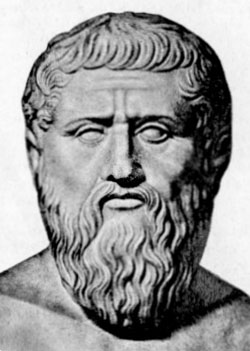
Plato
Paul said, “To live is Christ, and to die is gain.” Mr. Shank feels that, “no matter how that is exegeted,” it still means a Neoplatonic, mystical wish to transcend one’s creaturely limitations. Space doesn’t permit a full exegesis of the verse here, but I do think it can be exegeted without making Paul sound like a medieval flagellant. Take that word gain. I don’t think I would be twisting Scripture to insist that our very real “gain” at death (see 2 Cor. 5:8) will not include becoming gods ourselves. Death doesn’t deify. Agreed? Okay, then even after death, regardless of the benefits, we’ll still be creatures, right? Therefore, when Paul spoke of the gain to be received at death, he was not speaking of “transcending his creaturely limitations,” correct? Voila! You have just read an exegesis which, incredibly enough, did not lead to Neoplatonic conclusions. (I didn’t do it with mirrors. It’s actualIy pretty easy. All you have to do is this: Don‘t start with Plato, and you won’t end up with him,)
In concluding this section, I must comment on Mr. Shank’s statement about “wilderness theology.” I don’t really know what he means by the term (in some circles, that may be a damning admission). But I do know this much: the basic idea in the wilderness was to get through it as soon as possible, and get on with the conquest. God didn’t want His people to stay there, and their 40-year “wilderness experience was a judgment. It certainly wasn’t anything to be proud of. The Jews dropped dead learning their wilderness theology, and it was their children who learned “Promised-Land Theology.” They left the wilderness to the buzzards and mystics, and moved onto victory. I’m with them.
THE PIETY OF THE PURITANS
I agree (finally) that “the pursuit of biblical piety” was important to the Puritans. Circle the word biblical, and see the section headed “Christian Piety” above for my definitions. Moreover, I know of no reconstructionist writer who has ever scorned their heavenly language. There is nothing essentially wrong with talking about heaven. It is wrong only when it becomes a means of escaping from earth and the duties God has assigned to us here and now. The Puritan longing for heaven was biblical and realistic, and it was balanced with their deep sense of calling. As William Hailer wrote: “Men who have assurance that they are to inherit heaven have a way of presently taking possession of earth” (The Rise of Puritanism, [1938] 1972, p. 162). Their Anglican contemporaries talked about heaven also; but there was a significant difference, according to John F. H. New: “Anglicanism was a religion of aspiration, and Puritanism of perspiration” (Anglican and Puritan: The Basis of Their Opposition, 1558-1640, 1964, p. 104). The Puritans wanted heaven, but they wanted earth, too. They believed that all things were their inheritance in Christ (Rom. 8:32); they believed in an earthly victory for the people of God; and they went ahead and took possession.
Consider just one example (I could give many)–that of the great Scottish Puritan, Samuel Rutherford. He is known to many Christians through his oft-reprinted Letters (the most recent edition was published last year by Moody Press). Every page of this book reflects his all-encompassing devotion to Jesus Christ and his longing to be eternally in His presence. The intimacy of Rutherford’s expressions is almost embarassing–it’s like reading someone else’s love-notes. But Rutherford was no pietist. He wrote another work called Lex Rex (published last year by Sprinkle Publications)–sort of a 17th-century version of The Institutes of Biblical Law. In his day it was a political blockbuster, and he would certainly have been executed for writing it if he hadn’t died first. Charles II had to content himself with publicly burning the book.
My point is this: Considering the state of the present debate between the Pietists and the Reconstructionists, it seems incredible that the two books were authored by the same man. Many who like the Letters would think Lex Rex too “carnal” and “worldly”; and (I fear) some who enjoy Rutherford’s politics would disdain to read his more “devotional” works. For my part, I wish the two groups would get together. Rutherford himself does not appear to have realized he was doing anything extraordinary. What looks to us like “two strains” m his thought was really one: all-out devotion to Jesus Christ in every area of life. When it was appropriate, he wrote poetry about his personal relationship to Jesus; and when it was appropriate, he exuberantly blasted royal absolutism and laid down the biblical principles for a just law-order. Do you see a dichotomy or inconsistency in this? I don’t, any more than I see one between Remans 8 and 13. It’s the same man writing in each case. More importantly, it’s the same Lord, who is over all.
Admittedly, reconstructionism can degenerate into an unbiblical externalism, just as the theonomic revival under Ezra became warped and turned into Pharisaism. But it doesn’t have to–and it does only when we forget the principle of Jesus’ lordship over all of life. The Bible commands both personal devotion and cultural transformation according to biblical law. We should heartily abhor any “either-or” mentality about these things. We don’t need to abandon one for the other. True piety must include both. But we must be sure to get our standards for both from Scripture alone. We must not baptize the immoral writings of a gaggle of ancient Greek homosexual “philosophers” in order to find out how to get close to God. That has been one of the most serious errors of the past two millennia of church history, and it is taking centuries for us to get out of it. Some sections of the church haven’t moved a step beyond Aquinas on this point. On the other hand, it may be easy for some of us to react by falling into the opposite error–and, even though I believe Mr. Shank is mistaken regarding certain aspects of both the problem and the solution, I also believe he is sincerely trying to correct us on this point. We do need to warn one another against sin, and nothing is so easy as fleeing from one sin into the clutches of another. We must reason together on the basis of Scripture, and I invite further comments from interested readers (although I cannot promise to devote this much space to the subject in the near future–we have to get back to the Christian school business). The answer will always be genuinely biblical piety, and the direction will always, and only, be found in God’s inerrant word.
There’s a newly formed organization and a new online resource out now that is dedicated to promoting biblical Reformed theology and the rich pastoral and exegetical legacy of the late Rev. David H. Chilton.
I wanted to bring it to your attention because this is exactly the kind of online resource we’ve been needing to preserve, promote, build upon and share with succeeding generations the very important foundational and seminal work that Chilton produced before his untimely death in 1997 at the age of 45.
For those of you who are familiar with and appreciate the invaluable contributions Chilton made to the early Christian Reconstruction movement and the furthering of the church’s understanding of historic orthodox biblical theology from a Reformed perspective — and to defending that perspective against anti-biblical encroachments from both “conservative” as well as liberal persuasions — this is a very welcome development!
I am excited about what this will bring to the body of Christ in terms of making the exemplary literary and pastoral fruits of Chilton’s two decades of work more readily available to a much wider audience than ever before.
The website that has been created for this purpose is still in its early stages. But it is already showing tremendous potential in its use of the technology of the World Wide Web to, in its words, “cultivate the Chiltonian legacy in theology, liturgical arts, eschatology, and economics” and to “make the collections [of his work] accessible” to those in ministry, the academic world and to the general public.
All of Chilton’s books will be made available via download. Audio files will feature many of his recorded sermons and lectures. Topics will range from baptism to eschatology to worship to economics. Articles that he wrote for the various publications and periodicals over the years will also be posted.
As I have previously written, Chllton’s legacy is one of an energetic and eminently intelligent biblical expositor and pastor who had a rare gift for taking profound and sometimes controversial theological themes and making them vivid and powerful and at the same time understandable and quite simple to grasp. He spoke and wrote conversationally with sincerity and clarity rather than academic or rhetorical obscurity.
All of his books and articles reflect that unique ability. We’ll continue to post occasionally here some of the articles that he wrote for ICE and Dr. Gary North.
If you haven’t had the pleasure of reading any of David Chilton’s excellent and very enjoyable, insightful and edifying books like Paradise Restored, The Days of Vengeance, The Great Tribulation or Productive Christians, or listening to his highly instructive audio messages, this is your opportunity to find them all in one place, “under one roof” and at your fingertips, so that you can begin a rather satisfying intellectual and spiritual journey towards biblically sound doctrine and a scripturally solid reassurance that, in Christ Jesus and through the covenant promises of His Gospel, your present and your future as well as the present and future of this world are in very good hands!
I commend the contributors to this project for their commitment to undertaking such a highly desirable and godly educational enterprise.
Thanks to all of you! (And a special thank you to Mr. Steve Macias.)
A “biblical theology of dominion” and an eschatology of hope and victory — all of which Chilton wrote about eloquently and compellingly — are exactly the kind of legacy and spiritual and temporal inheritance that Christians everywhere need to recapture, rediscover and reclaim, to fully execute the Gospel mandate in America and around the world. This new work is one more in our arsenal of Spirit-empowered, covenantally sanctioned and scripturally defined tools to do that.
Forgive me if I don’t seem to be enamored with the new “emerging” breed of Calvinists that has cropped up and become all the rage in Reformed and conservative evangelical circles during the past 7-10 years. And forgive me if I dismiss them as five-point evangelicals and ‘sovereign-grace antinomians.’ But, frankly, based on what I have seen over the last few years, that is how I perceive them.
Don’t get me wrong. I’m glad that the term ‘Calvinist’ now carries less of the baggage and unwarranted stigma of “cold, narrow, non-evangelistic” and even “heartless” Christianity that it did in the bad old days prior to the mid-to-late-20th-century revival of interest in the Puritans and Puritan theology. The Genevan Reformer and ‘prince of commentators’ has been much maligned and maliciously slandered for too many years by too many “Bible-believing” Christians.
What I am not glad to see is that what is being passed off to the Christian public as “new Calvinism” — i.e., a badly-needed update and remix of the “old” Calvinism — appears to me to be really just a thin veneer of Reformed doctrine applied to the existing populist hull of American evangelicalism.
The first time I heard about “New Calvinism,” was probably only about three years ago when I was doing some online searching for a Reformed theological topic. I don’t remember exactly what the topic was, but I know it had something to do with Calvinism (and probably eschatology). I came across a TIME magazine article from 2009 that mentioned New Calvinism as one of the “10 Ideas Changing the World Right Now.” Seemed like a bit of really good news at the time.
Finally! The legacy of John Calvin is getting its due. The recognition, vindication and audience it deserves — and in a venerable old “mainstream media” outlet like TIME. At last, the seeds sown by 20th-century purveyors of predestination, election and TULIP-driven theology were starting to sprout amongst the newest generation of younger Christians. “Generation C.” Finally, rampant evangelical Arminianism had met its cultural and ecclesiastical match. Score one for our side!
But, alas, that sense of elation, gratification and vindication was short-lived. At least for me. Once I became more aware and more familiar with what some of the ‘New Calvinists’ were teaching and preaching (and in some instances, how they were preaching it) — given the more holistic covenantal Calvinism, theonomic-postmillennial-Reconstructionist theology and historic Reformed doctrine and creedal confessions that I subscribe to — I became more uncomfortable and less enchanted with the latent anti-Calvinist, antinomian and quasi-biblical aspects of it.
No small, cultish phenomenon, this. It has caught on like wildfire in some Reformed and evangelical churches. It has taken the Southern Baptist Convention by storm. (And not a perfect one, either.) It has found its way into ‘conservative’ Reformed and Presbyterian denominations. It has opened up a whole new market for charismatic continuationist theology! And it has resulted in a lot of ‘young, restless and reformed’ Christians packing non-traditional churches to hear “unchurchy” sermons preached by “unchurchy” pastors, and worship to “unchurchy” music.
What’s Going On Here?
I have first-hand experience with some of the changes wrought by New Calvinism as it finds its way into the sanctuaries, pews and pulpits (the “DNA”) of otherwise Reformed-Calvinist churches. Some of the changes are more architectural and visual rather than doctrinal. But they are subtle (and some not so subtle) and unmistakable.
First, the pews get taken out. (That’s so Old Calvinist!) Upgrading to the new, plastic, fold-up chairs. Out with those warm, inviting community and family-friendly benches. In with the new, individualistic, one-size-fits-all, pack-em-in-like-sardines-for-Jesus theater seats!
Then the accoutrements of traditional Christianity get removed, especially well-lit worship spaces. Replaced by dark, spooky, theater-like venues with all sorts of lighting effects to “enhance” the worship experience. LOUD, pulsing musical numbers combined with soft, sentimental ballads played by talented and gifted folks who transform every worship service into a garage-band, ultra-casual, youth-group-style performance. An occasional hymn, updated, for old time’s sake. “A” for effort, guys (and gals). But, whatever happened to being offered a choice between “contemporary” and “traditional” worship?
But What Are They Teaching?
Well, they’re not teaching Calvinism, that’s for sure. At least not Calvin’s Calvinism, in my opinion.
Oh, there’s talk about God’s sovereignty, grace, the depravity of man, the holiness of God, authority of the Bible, power of the Holy Spirit, transformative impact of the Gospel, etc.. Generic Calvinism. But beyond that, what’s missing is the full-orbed, rich and all-encompassing theology of historic Calvinism. The “new” version is more of a truncated, boiled-down mixture of pietism, TULIP soteriology (with a few bulbs missing) and mainstream evangelical-cultural accommodation, and a heaping helping of doctrinal ecumenism.
A Case in Point
Here is what one of New Calvinism’s pastoral frontmen, Mark Driscoll, had to say when commenting on that TIME magazine article:
FOUR WAYS ‘NEW CALVINISM’ IS SO POWERFUL
Old Calvinism was fundamental or liberal and separated from or syncretized with culture. New Calvinism is missional and seeks to create and redeem culture.
Old Calvinism fled from the cities. New Calvinism is flooding into cities.
Old Calvinism was cessationistic and fearful of the presence and power of the Holy Spirit. New Calvinism is continuationist and joyful in the presence and power of the Holy Spirit.
Old Calvinism was fearful and suspicious of other Christians and burned bridges. New Calvinism loves all Christians and builds bridges between them.
Now, go back and read through those four points again, slowly…
Is it just me or is this just a REALLY misinformed and badly distorted misrepresentation of “Old” vs. “New” Calvinism?
“Old Calvinism was fundamental or liberal.” “Separated from or syncretized with culture.” “Fearful of the presence and power of the Holy Spirit.”
“New Calvinism is missional”“Seeks to create and redeem culture” “… is joyful in the presence and power of the Holy Spirit”
“New Calvinism loves all Christians and builds bridges between them.”
“Old Calvinism was fearful and suspicious of other Christians and burned bridges.”
Huh?
A better name for this would be, “Four-Point ANTI-Calvinism”! Historically inaccurate and theologically misleading about what it claims to be a resurgence of.
In the short time that New Calvinism has been with us, it has stirred up a hornet’s nest of controversy and interest. Its leaders have become household names (and lightning rods) in their own right among “Bible-believing” Christians around the world. Besides Mark Driscoll, there is Albert Mohler, C.J. Mahaney, Tim Keller, and of course, New Calvinism’s “senior pastor,” John Piper, and others. Obviously, these men have all had very good and quite biblical things to say about any number of issues over the years. But there have also been some troubling aspects to their teachings and beliefs — publicly stated and publicly propagated, which means it is perfectly legitimate and valid to criticize them and ‘call them out’ on it in public — things which should dismay a good number of you, and ought to otherwise undermine some of their credibility and “disqualify” them from occupying their lofty perches as peerless, unassailable fonts of theological knowledge, as many conservative and Reformed Christians hold them out to be.
What Would Calvin Do?
‘New Calvinism’ has gained such a foothold and garnered such a sizable audience and made its formidable presence known in such a big way across the evangelical and Reformed landscape during the past decade, that I think I may take a closer look at it in future posts.
I’m just a layman. And I’ve got no “dog in the hunt” here. And I may be completely off-base in my impressions and my analysis. But I just wanted to share my two cents’ worth and voice my personal perspective on this. As a Calvinist and as a Reconstructionist.
While the media and the public continue to play Monday morning quarterback following the jury verdict handed down in the Zimmerman trial last weekend, there is a certain question in my mind that I have not seen asked by anybody.
The question is this:
How many potential crime victims of Trayvon Martin have been saved, and how many of his potential, future crimes and violent acts against others have been avoided and averted since Feb. 2012 when the tragic shooting took place?
Obviously, that’s a question no one can answer. But the fact is, had this seriously delinquent young man lived, who knows how many more people would have been his unwitting victims as his budding career as a street thug and heartless criminal was just starting to take off.
The highly manipulated image of Trayvon as just a mischievous kid who was innocently walking down a rainy residential street one night with a bag of candies and a soft drink in his hand when he was suddenly accosted by a “white Hispanic” racist-aggressor, skinhead-in-disguise-with-a-gun (and-no-badge) George Zimmerman, was (and still is) just that — an artificially crafted and controlled image and prejudicial narrative that the “mainstream media” and the corrupt political establishment in Washington have worked furiously to maintain throughout the entire unwarranted murder trial.
Nobody is glad to see a 17-year-old, regardless of his race, meet with a violent and untimely death like this. But there are PLENTY of people who would not only be glad but absolutely elated and overjoyed to see the “antagonist-perpetrator” 28-year-old in this made-up saga meet with as violent and untimely (and brutal) a death as possible!
What Would Jesus Have Done?
Some high-profile “Christians” (Jim Wallis) have vigorously denounced online and in-print both the outcome of the trial and the actions taken by Mr. Zimmerman that night in February 2012.
But the issues of self-defense and the use of lethal force against another person — and the quasi-issue of racism — are not the subjects being dealt with here. (I’ve addressed the matter of guns and self-defense from a Christian perspective in a previous article.)
The issue I’m bringing up is that, in this particular case — as in so many others that are not obsessively covered (twisted, distorted, co-opted) in the media and by the pro-criminal establishment — the net result of the altercation was the immediate halting (via death) of the violent, injurious and potentially deadly actions of the perpetrator, aggressor and law-breaker, and the protection and preservation of the life of the real victim, the non-aggressor and non-violent law-keeper (volunteer law-“enforcer”).
To throw a bone to the “WWJD” crowd, let it be made perfectly clear that Jesus came to fulfill, satisfy and scrupulously NOT disannul, disavow and deny, but rather “preserve, protect and defend” the continuing force and validity of the unbreakable, immutable and perfectly righteous and holy Law of God. He himself was judged by it. So, what would Jesus have done? Frankly, nothing that would have been in any way contradictory or in violation of His Father’s Law! And he would want his followers to do likewise. Biblical law is a system of justice and equity based on restitution and restoration, not revenge.
Stripping away the thin veneer of falsehoods and omissions that were contrived from the beginning to conceal the true facts of this shooting, one is left with a simple case of a young man acting defensively and, yes, desperately in response to a vicious, unrelenting and violent physical assault brought on by another young man, who was clearly acting offensively, hatefully and with undue force and without any restraint.
God’s law, properly applied, would hold the first young man innocent of wrong-doing because he was acting (actually reacting) solely in self-defense of his person to preserve and protect innocent life — his! That law would also likewise hold the second young man guilty of acting unlawfully and unjustifiably to intentionally cause physical harm and serious injury (and possibly death, we’ll never know) to another.
He that smiteth a man, so that he die, shall be surely put to death.And if a man lie not in wait, but God deliver him into his hand; then I will appoint thee a place whither he shall flee. But if a man come presumptuously upon his neighbour, to slay him with guile; thou shalt take him from mine altar, that he may die. ~ Exodus 21:12-14
If Trayvon had lived, God’s law — biblical law — would require him to compensate George Zimmerman fully for the injuries he caused him: medical bills, lost income, etc. It would require the guilty party, the perpetrator, the aggressor, NOT the TAXPAYER or the STATE, to make restitution to the victim.
And if men strive together, and one smite another with a stone, or with his fist, and he die not, but keepeth his bed:If he rise again, and walk abroad upon his staff, then shall he that smote him be quit: only he shall pay for the loss of his time, and shall cause him to be thoroughly healed. ~ Exodus 21:18-19
If Trayvon had lived and continued his life of crime and violence and burglary and theft and “substance abuse” and possibly (later on) rape and murder or manslaughter (which he might well have committed and been guilty of in this instance if Zimmerman had not had a gun!), then he would be liable under God’s law to be punished to the fullest extent by relinquishing his life via the civil authorities administering capital punishment — utilizing private citizens to actually carry it out (ex. Numbers 15:36, Joshua 7:25, I Kings 21:13), but that is another non-pietistic, anti-sentimentalist aspect of biblical law for another day! — as this would be the only form of restitution available to him to somehow “compensate” his past and present (and future) victims and their families, for their losses. And most of all, restitution owed to the holy God whose justice and “legal system” requires man’s blood for the shedding of innocent blood, and for incorrigible, violent repeat-offenders whose presence in the community poses a continual threat to the life and safety of others.
All of this is based on the original principle of the “sanctity of life” (innocent life) set forth by God:
Whoso sheddeth man’s blood, by man shall his blood be shed: for in the image of God made he man. ~ Genesis 9:6
That is the hard truth of it. No sentimentality or emotion or political expediency or practiced prevarication should be allowed to influence prejudicially and corruptly the outcome of a case that is so clearly “open-and-shut” and an obvious one of justifiable self-defense not meriting a trumped-up show trial lasting one and a half years!
A far more desirable outcome — infinitely more desirable — would have been for Trayvon to have lived through the encounter, hopefully learned from it as well as his past “indiscretions” and offenses, and brought to saving faith in the Gospel of Jesus Christ and experienced forgiveness and emotional healing and full and free redemption, and thus had a very different life after that. But, tragically, regrettably, that didn’t happen. Only the mysterious providence of God can explain why.
One More Thing…
Something else that comes brilliantly through in this travesty-turned-vindication-of-justice is this. Jury trials are probably one of our last, best hopes to defend ourselves against advancing government tyranny and the encroachment of the state and trampling of our rights via power-hungry politicians, self-serving and wicked public figures and state-worshipping “leaders” and an ungodly legal system that is increasingly prone to manipulation and convolution and distortion of truth and the adjudicatory process, and the promulgation of falsehoods and lies in the name of “justice.”
Juries, Justice and God’s Law
Here again, we see the biblical model in Scripture:
Know ye not that we shall judge angels? How much more things that pertain to this life? ~ I Corinthians 6:3
From a covenantal and theonomic standpoint, jury trials are an excellent example of God’s law in action through self-government: private citizens judging matters at law themselves that involve other private citizens, by applying the law themselves to the facts of the case brought before them. Their decision can go against the judge, the state, even against the law itself — jury nullification — and most especially (and necessarily) against the general public, who almost never has access to all the facts of the case as they do. And best of all, despite all that opposition and contradiction, when a verdict is handed down, their decision STANDS!
So if I’m ever involved in a life-threatening situation where I am compelled to act radically and forcefully in order to defend myself (or my family), and my actions result in the death of the perpetrator-aggressor, I would certainly hope and pray that, if I had to be tried in a court of law, I would be judged by a jury of my peers — even if they were all women! — who understood what was truly at stake and were not influenced by the popular media or a willfully (and woefully) ignorant and easily manipulated and prejudiced public, not kow-towing to external pressure (thank God for sequestration) on them to find the case a certain way, but would, rather, judge righteously all the facts, and even the law itself, and make a decision and reach a verdict that would ultimately preserve law and order and justice and continue the precedent set by our biblical (and some of our political) forefathers, who recognized that “liberty and justice for all” only happens when all are informed and all are equally and equitably applying God’s law and principles to every area of life.

 Today’s observance of Martin Luther King Day seems like a good time to compare the racial and political ideologies that gave rise to the civil rights movements of the 1950s and 60s — and the creation of the national holiday honoring King in the 1980s — with the biblical and historical motivations that undergird the theology and tactics of Christian Resistance.